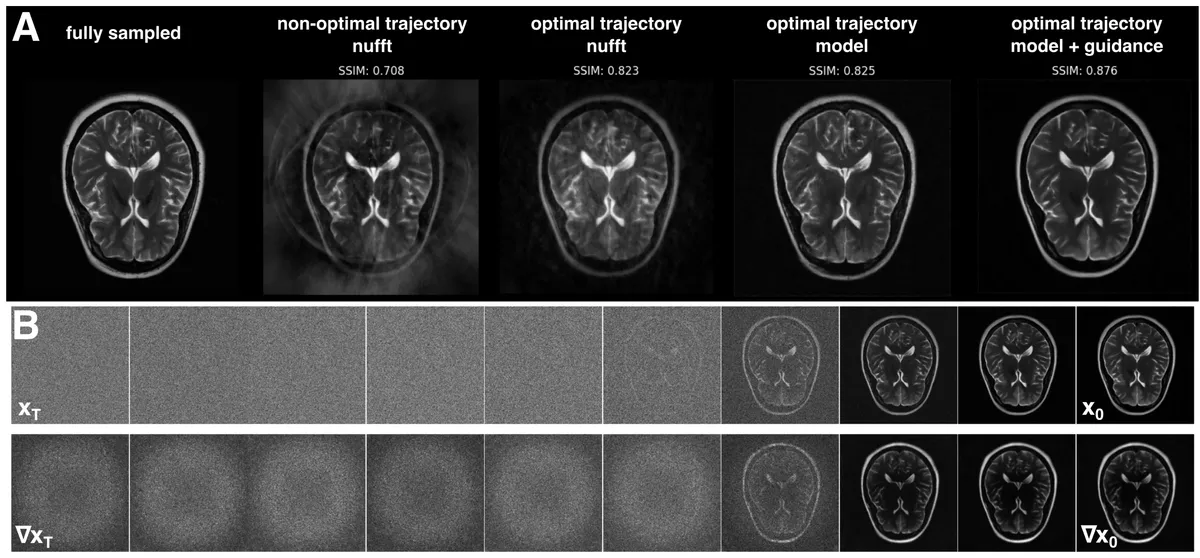
(A) Effect of sampling trajectory optimization, model reconstruction without frequency guidance, and model reconstruction with frequency guidance. For the non-optimized trajectory, we used a single interleave Archimedean spiral with a readout duration of 0.02 s. The optimized trajectory uses a 23 interleave, α = 1.23 sequence with an identical readout duration. (B) Snapshots of the image latent xt and the gradient signal ∇xt taken during a diffusion sampling process.
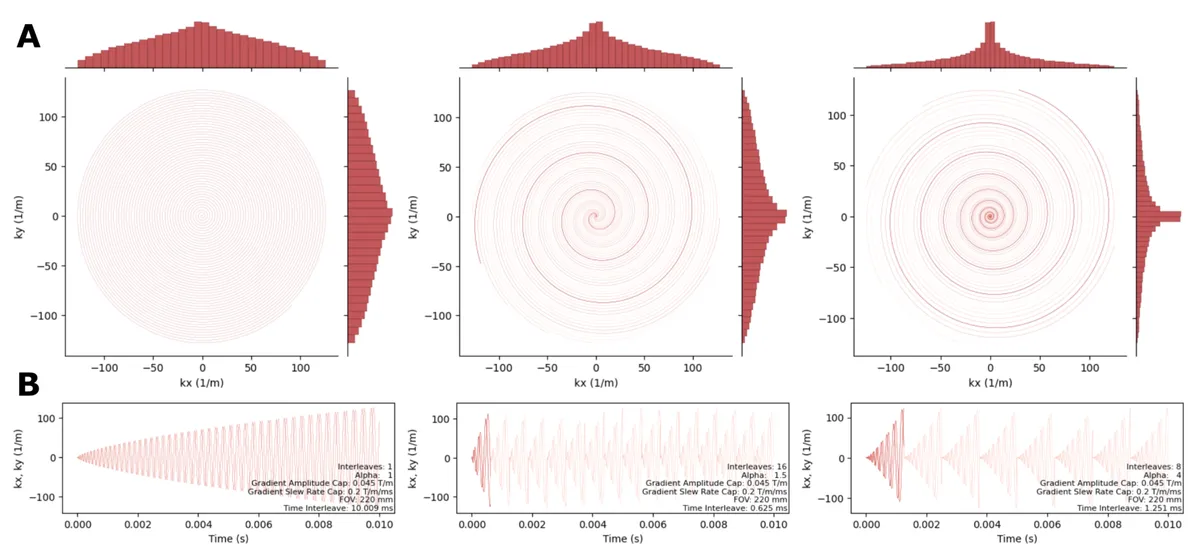
Example trajectories (A) and the corresponding readout gradients in kx and ky (B). All trajectories shown cover the frequency space of a 256×256 image and have a readout duration of 10.0 ms.
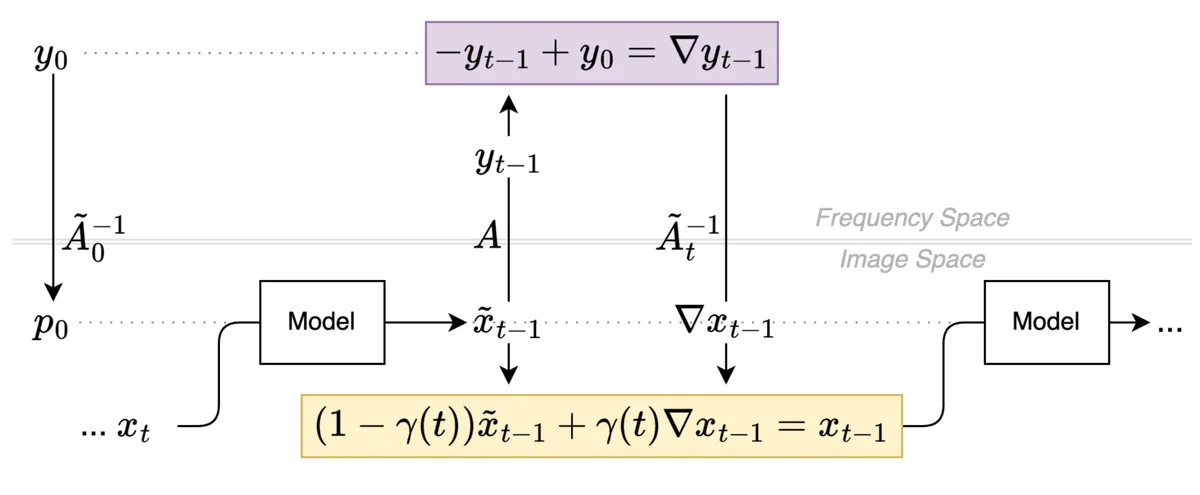
Given measurements y0, reconstruction follows a modified diffusion sampling process. At each timestep, a noisy latent xt is concatenated with a prior p0 and passed to the denoising model to obtain x̃t−1. To enforce consistency with y0, we compute a frequency gradient ∇yt−1 and solve for the image gradient using a modified iterative inverse NUFFT (section 3.3). A weighted sum of xt−1 and ∇xt−1 yields the corrected image xt−1. This is repeated until t = 0.
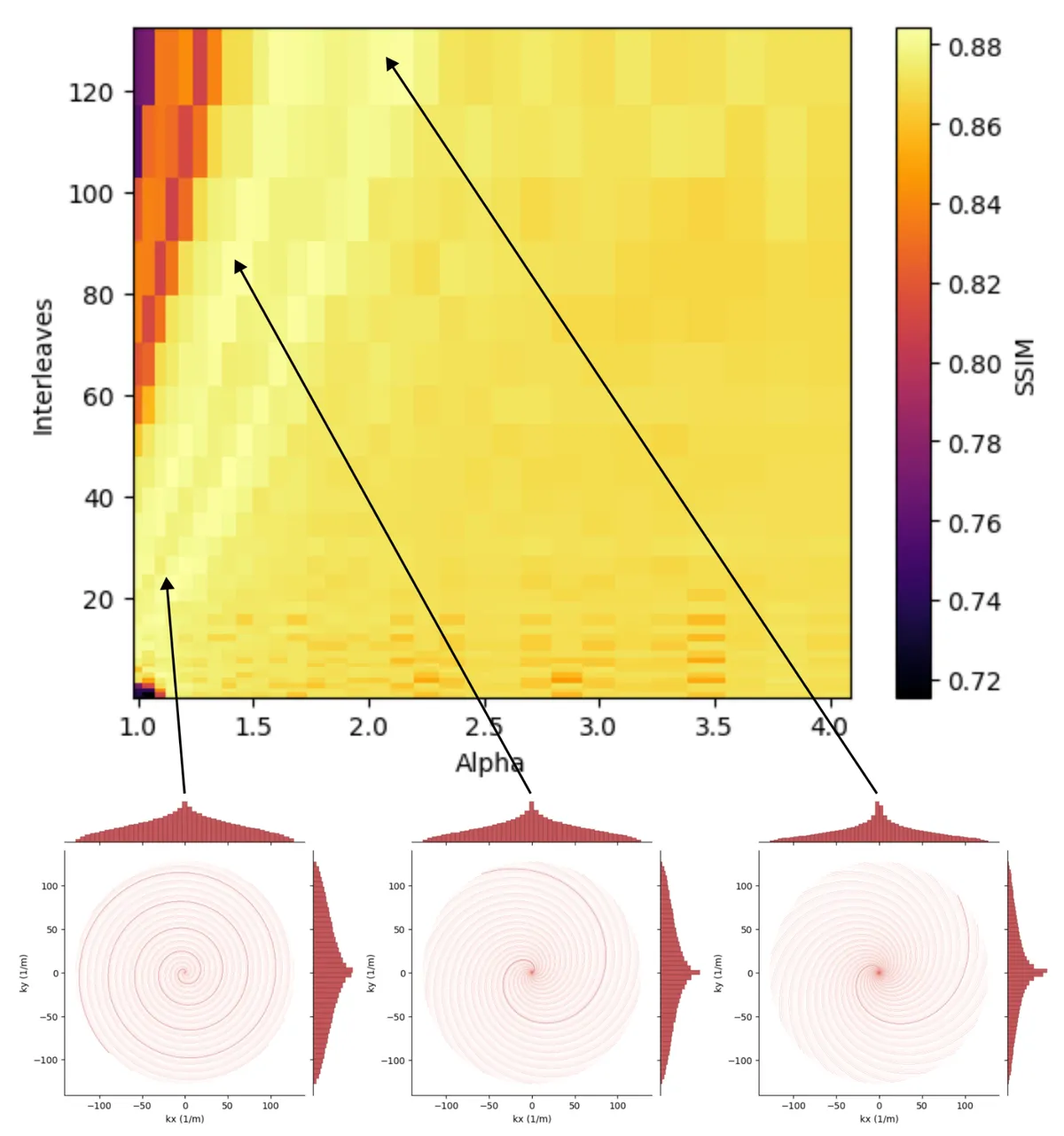
We performed a grid hyperparameter search over a 2D trajectory space. We fixed readout duration at 0.02 seconds and varied the number of interleaves from 1 to 125 and α from 1 to 4. Based on structural similarity of the model-reconstructed images, we found multiple trajectories that yield improved image quality. In comparison, the naive Archimedean spiral, corresponding to 1 interleave and α = 1, performs very poorly.